ASU researchers, Phoenix work to curb heat-island effect
A cactus blooms in the desert outside of Apache Junction. The warm climate has long been a draw for people but growth and development is now making the state even hotter, possibly impacting population growth for the future. Photo by Brittny Goodsell
By Brittny Goodsell
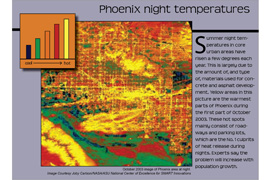
PHOENIX – On a helicopter ride above the Valley as it slept, Arizona State University professor Harvey Bryan and his colleagues used an infrared camera to see which areas retained heat long after the sun had set.
The result: Flaming red where pavement now covers the desert floor.
“What is glowing at 2 and 3 a.m. is the street and parking lots – that’s telling us the problem,” Harvey said.
For decades, a climate featuring mild winters and bearable summers has helped fuel growth in Phoenix and other cities in central and southern Arizona. But Bryan and other researchers say that growth is helping make those cities hotter and exacerbating the effects of climate change.
“We may be put out ourselves out of existence with the temperatures we’re aspiring to through this growth,” said Bryan, with The Design School in ASU’s Herberger Institute for Design and the Arts.
The problem: Concrete and asphalt in the cities absorbs the heat of summer days and releases it at night.
The effect, called urban warming or the heat-island effect, has made nighttime temperatures 10 to 12 degrees hotter than in the past, Bryan said.
And then there’s the pressure on the electrical grid and people’s wallets. Seeking relief from higher temperatures, people are using 15 percent more electricity on air conditioning today, Bryan said.
Unless cities’ design policies change, Bryan said, temperatures will continue rising as population growth leads to more paved areas. Designers and city officials need to look, among other things, at materials used for roadways and parking lots, he said.
“We are paying for the changes that we’ve had in our climate over the last 50 years,” Bryan said. “It will be more and more common as we move into this condition unless we don’t start to address it.”
Experts at ASU are collaborating with the city of Phoenix to develop ways to mitigate increasing temperatures, said Carol Johnson, planning manager in the city’s Planning and Development Department. Solar screens and cooler roof materials will be used in new construction as part of required design codes, for example.
It will be a bigger challenge to address existing buildings and roadways, since design codes apply only to new construction, she noted.
“We are limited but it’s a start,” Johnson said.
One of the first buildings to incorporate some cooler building materials is the downtown Arizona Cancer Center, which is currently in the planning review process.
“The city doesn’t have a magic wand where we can bring existing development and new development up to the same level, and now during this time of slow development, we’re just not getting projects to come in,” Johnson said.
Bryan said planting more trees or designing more canopies of vegetation around the city can also help. Using vegetation that requires watering means the atmosphere around the vegetation feels cooler, creating a lower temperature in parts of the city.
Although Bryan said he understands the need for landscaping with desert-friendly plants in hot areas, there are other times when an “oasis” type of vegetation help cities control rising temperatures. Sometimes solutions require doing contradictory things, he says.
“It’s a combination of things,” he said. “It’s a sort of mitigation for the mistakes you’ve made of the past 40 or 50 years in a reverse way to create a better outcome.”
U.S. Congress gets air conditioner
No more hot air in Congress. On June 17, 1938, 2 million cubic feet of clean, cool air was delivered to members of Congress each minute by a $3.5 million air conditioning plant, part of which is shown above.
Photo and caption from Library of Congress Prints and Photographs Division Washington
The Valley in infrared
Click to view an infrared image of the Valley at night.
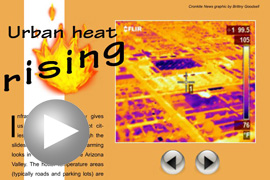
Click the interactive graphic to see how urban warming looks in downtown Phoenix. Different colors are reflective of different temperatures. (NOTE: This display requires the latest Flash player, which is available here.)
Graphic by Brittny Goodsell
Life before air conditioning
Click to read a native’s story about living in Arizona before air conditioning. Hannah Volkenent remembers her family’s first car air conditioner and homemade swamp cooler.
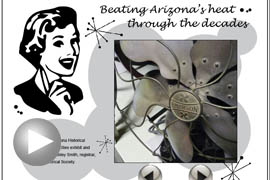
Click the interactive graphic to explore the different types of air conditioning units and fans used in Arizona during the middle of the 20th century. (NOTE: This display requires the latest Flash player, which is available here.)